
Hello, and welcome to yet another edition of The Black Cat.
Feel free to send it around, email me your reflections, and follow me on Instagram at dominicmadori.
This month I’m reading: The Door by Magda Szabó and The Sin of Abbé Mouret by Émile Zola
This weekend, I can’t stop listening to: “Can’t Take My Eyes Off You — Original Extended Version” by Boys Town Gang
Lately, I’ve been thinking about community.
As I’ve gotten older, I’ve realized how much selfishness has permeated society; how individualistic mindsets have left us without the social safety nets that once made life bearable. We make excuses for it, mainly saying we are tired of being inconvenienced.
Then we grow up, feeling as if the basic qualities of human interaction — showing up and checking in — are inconveniences, and look around and realize no one is there and no one wants to be there. Life was not meant to be lived alone; the structures of society and the wiring of nature say it so, and I think that the era of selfishness should come to an end. People are overwhelmed in ways they’ve realized yelling in the internet town hall will never fix. They need the outdoors. They need their friends. They need their families.
Earlier last month, I attended an event hosted by Rich Little Brokegirls and Fan of Your Brand called Take Care Wine Night with Lancôme. We were all ambitious women coming up in this era that prioritizes the self at whatever it takes. The conversation was multigenerational, with older Black women telling us that we are going to get married, divorced, sick, and so forth, and we are going to want to call up the phone and inconvenience someone one day; we are going to want to be inconvenienced ourselves. We are going to want to stimulate those chemicals in the brain that only come when you are with someone whose laugh you could never forget. Then the young ones spoke about how they have started reaching out to people for no other reason than that person crossed their mind. I’ve started doing that, too.
When I first entered the media industry, I put work above everything else. But the most fulfilling year of my life, work included, was when I better calculated how to spend time with friends and family, saying no to work events to go to the birthday party, or saying no to conferences to go to family reunions. I grew that year and have every year since, to know that, like groups of Black women coming together, like what happened earlier this month, was perhaps the most important event I would attend that week. When I went to a predominantly white university and moved to the Upper East and West Sides of Manhattan, I almost became used to the feeling of difference. It was as if I were a perpetual solo traveler in my own life, except that after a certain period, the vacationary solitude turned into loneliness. Then, I moved further uptown, and suddenly I was near my hair shops, the food I grew up eating, around people who looked like me, who worked like me, who listened to the same music I did, and who knew the shows I knew. I found community. This social net is actually one of safety. In the world alone, there is the internet, and then the confines of our minds and apartments. This is not a safe place to be.
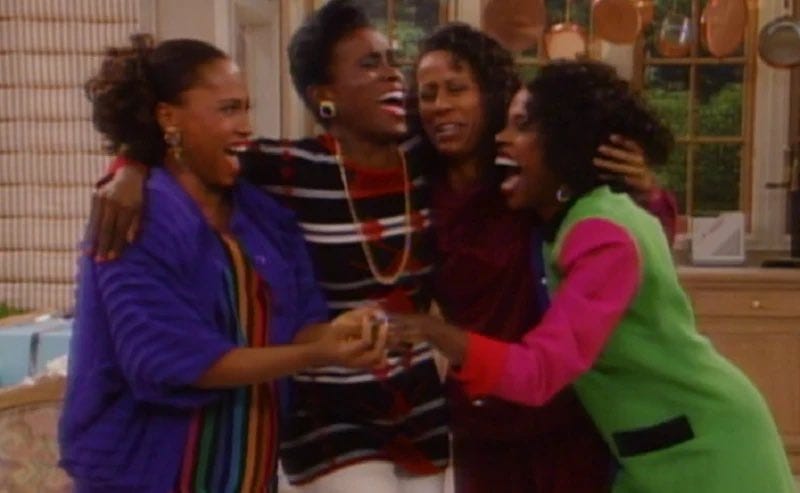
At the gathering on Wednesday, we spoke about the tiers of friendship. There are some friends to whom you can vent your whole life, others who are better assistance for more serious problems, some when you just want to hear the truth, and those to bring around for a good time. All create an important pyramid of social interaction that many of us learned to cherish in TV shows, like in “Girlfriends,” “Insecure,” and “Harlem.” I was chatting to someone recently about a debate I once saw on Twitter about third spaces — the communal places that Black people used to frequent — that have changed. For many of us, church was an obvious place to see people of the community, and in many ways it still is, though I would argue this is less so for younger generations, many of whom have become disillusioned with organized religion. But then I remember a tweet I once saw where someone asked why there were no more cookouts, and someone responded that people aren’t hosting them. I think about that sometimes when I throw little soirées. I don’t have a home, just a tiny apartment with a little view. But it’s not about the where; it’s about the who. Oftentimes, I am compelled not to even have anything official. Just come over. Like when we were kids and just hung out for no reason. I had a sleepover with some girlfriends a few months ago — we hit the clubs, came home early in the morning with Popeyes in hand, then fell asleep in the living room. Our parents don’t need to pick us up or drop us off anymore, and yet, now, with my own free will, that was the first sleepover I’d had since childhood.
Now, living in Harlem, I see people gather just to gather, and oftentimes, you can just read a flyer and show up. I’ve started going to more events — both intentional and unintentional — and find them unique in their ability to enrich the roots of life. It reminds me of a founder I met with a few weeks ago, who explained that mushrooms, fungi, actually connect the roots of trees beneath the surface of forests so they can communicate and support each other. Then and there, I understood that nature had it all figured out. Even trees are not living in this world alone.
My goal, then, for the rest of my life is more community. More catch-ups. More sleepovers. More friends. More love. More of what nature intends rather than what man rewards. People online say that capitalism and the market have left too many people tired of consistently seeking community. But none of that eclipses the weariness of being alone. A sign of aging, perhaps, is that now there’s nothing I love more than the summer season, when the chairs are out on the sidewalk, and people are just sitting around talking and drinking. There is a spillover at the local bars, parades on the streets, and the overall return of the human warmth suppressed during the winter months. Once, while at the bus stop last year, a young woman came up to me and asked if this was the ghetto. “Why?” I asked. “Because,” she responded, “there are people outside doing nothing but hanging around.” I looked around and realized she was right and wrong. Right, in that people were just hanging around, but wrong in that they were doing nothing. Had she never wanted to grab a friend and just bask in the summer sun?